
Table of Contents
- What is a chatbot, and how are AI chatbots different from older bots?
- How do rule-based chatbots work with predefined responses?
- How does AI change chatbots’ language understanding and response capabilities?
- What are AI chatbots better at, and where do they need human oversight?
- A checklist for choosing the right chatbot for your business or personal needs
- Frequently Asked Questions
What is a chatbot, and how are AI chatbots different from older bots?
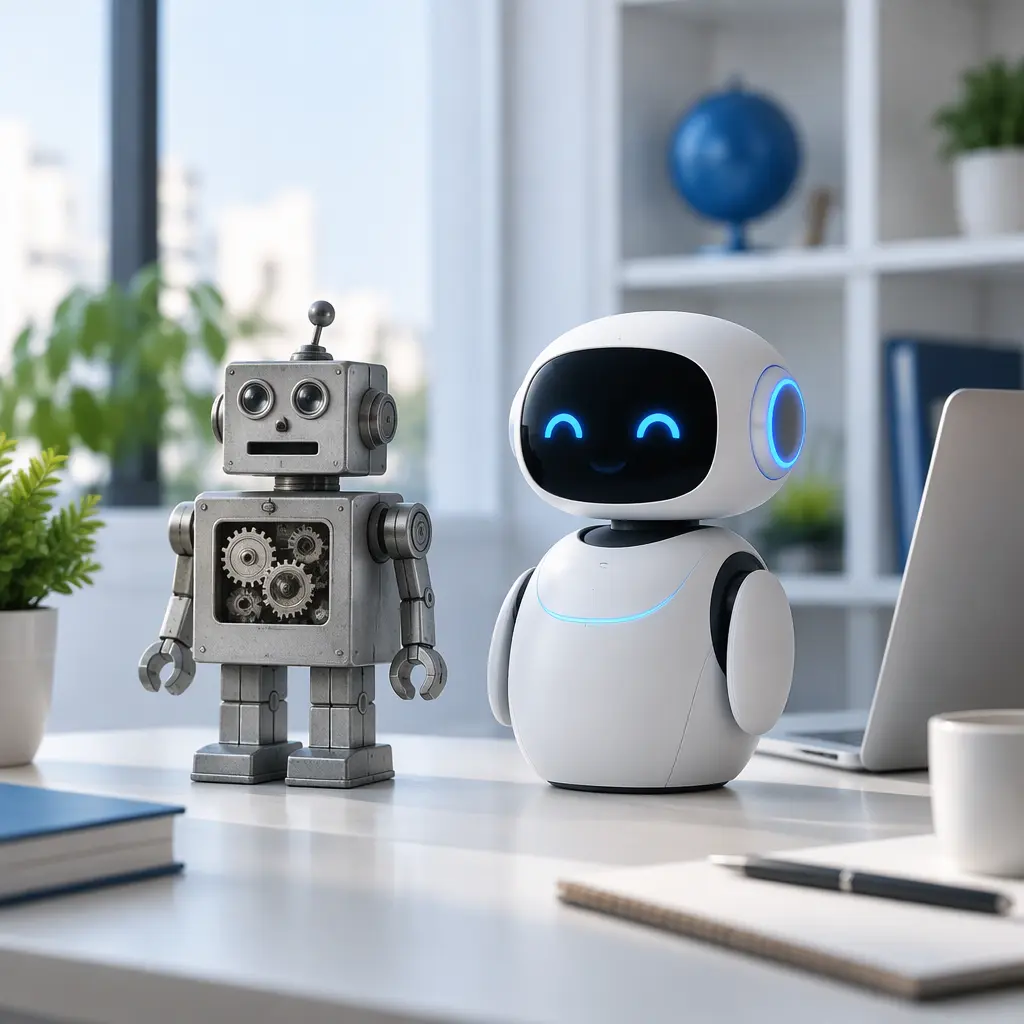
A chatbot is software that answers user questions or performs tasks through conversation. Older bots typically operate according to prewritten rules: if a customer selects a specific word or option, they receive a designated response; otherwise, the conversation may reach a dead end. In contrast, AI chatbots can recognize the intent behind different phrasings and tailor their responses to the context of the conversation.
This difference matters in real-world applications. For example, a rule-based store bot can provide business hours or order status, but comparing several products requires predefined rules and paths. An intelligent system can understand a more complex request and generate a response using relevant information; however, response quality depends on reliable sources, up-to-date data, and well-designed safeguards. Solutions such as a bot connected to organizational knowledge help ensure responses are based on business documents.
During busy sales periods, such as the run-up to the holidays, automated responses can reduce the volume of repetitive questions; however, sensitive or ambiguous requests should be escalated to a specialist. The choice between a rule-based and an intelligent approach depends on the complexity of the questions, data sensitivity, and maintenance costs. Oxalis works on enterprise software solutions, and reviewing support processes before choosing a technology can help make the decision more precise.
How do rule-based chatbots work with predefined responses?
A rule-based chatbot selects a response by matching the user's message against predefined words, conditions, and paths; the scenario designer specifies a response or follow-up question for each input. Such a system usually does not interpret text like a human, and if a message does not fit its rules, it may give a generic response or refer the user to a human support agent. The quality of the experience therefore depends on carefully designed conversation branches.
For example, during a sales season, a store can link frequently asked questions about delivery times, payment methods, and return policies to fixed responses. By selecting an option or typing a phrase such as “track my order,” the user enters the relevant path, and the system gathers the necessary information step by step. However, changes to inventory or sales terms must also be reflected in the responses and rules; otherwise, an outdated answer during a critical period can confuse customers.
Rule structures and conversation paths
In the design process, first list the predictable intents; then define trigger phrases, responses, and alternative paths for each intent. For example, if a customer asks about “business hours,” the system can display the information and provide the next step if the customer asks for the address. Understanding the concept of artificial intelligence helps clarify the distinction between this approach and learning systems; fixed rules alone do not enable automatic learning.
To monitor performance, log unsuccessful conversations and add new user phrases to the rules. In highly competitive businesses, short paths and clear options are usually more useful than long menus; connecting conversations to customer records through customer relationship management can also prevent users from having to repeat information. Reviewing research on the benefits and limitations of this tool can also help assess practical considerations.
Limitations and when to refer to a human
Prewritten rules are more reliable for common, limited topics, but they are less flexible when faced with spelling mistakes, unexpected phrasing, or multiple requests at once. If a user asks about something outside the scenario, repeating the same fixed response can erode their trust. For this reason, options such as “My issue isn’t listed” and transferring the conversation to an agent should be built into the paths from the outset.
Before launch, test scenarios with actual customer questions and fix incorrect responses, repetitive loops, and dead ends. For sensitive requests, the system should not project false certainty; it is better to state its limitations and direct the user to a human. Research examples on the psychological applications of this technology also remind us that the context of use and type of conversation matter when designing responses.
How does AI change chatbots’ language understanding and response capabilities?
AI has enabled chatbots to move beyond relying on a handful of predefined phrases and instead identify the user's intent from their message and generate a more relevant response. Using natural language processing, these systems analyze keywords, entities such as product names, and relationships between sentences. For example, if a customer asks about delivery time and then says, “What about our city?”, a system that retains the conversation context can understand how the second question relates to delivery.
From intent recognition to response generation
Large language models generate responses based on patterns learned from their training data; this makes conversations more fluent, but does not guarantee that the responses are correct. For sensitive or changing information, such as product availability during peak sales periods, it is best to connect the system to a reliable data source and refer the user to a human when there is uncertainty. Reviewing the capabilities of AI chatbots can also provide a general understanding of how this technology is used.
Response quality depends on more than the model; conversation flow design, up-to-date data, and testing with real questions are also important. To assess results, teams can track the rate of requests resolved without specialist intervention and the rate of incorrect responses; choosing appropriate metrics is easier with key performance indicators. During seasonal sales periods, testing common questions before message volumes rise can reveal preventable errors.
The role of design and human oversight
For reliable responses, the system's capabilities must be clearly defined: it should automatically answer simple questions and hand ambiguous cases, complaints, or sensitive requests to a specialist. This requires proper implementation and maintenance; understanding the fundamentals of programming principles helps explain how connections to a knowledge base or conversation history are implemented. Oxalis works on software solutions, and you can discuss project details to review technical requirements and get advice.
Personal data should also be processed only as needed, and access to conversation histories should be restricted. If response quality drops during a particular period, review examples of unsuccessful conversations, revise the help content, and test it again with real questions. This monitoring cycle makes the system more useful without mistaking fluent language for factual accuracy.
| Feature | Rule-based chatbot | AI chatbot |
|---|---|---|
| Response method | Selects from predefined responses and paths | Generates or selects a response based on analysis of the message and context |
| Input type | Usually specific phrases or options | More open-ended language and varied phrasing |
| Flexibility | Limited to designed rules and paths | Greater ability to handle different phrasings |
| Need for oversight | Updating rules and predefined responses | Reviewing responses and handling sensitive cases with human support |
What are AI chatbots better at, and where do they need human oversight?
Tasks suited to automation
Chatbots perform well at answering repetitive questions, categorizing requests, and providing step-by-step guidance, especially when responses are drawn from reliable, up-to-date documents. For example, a store can automatically provide its business hours, delivery terms, or general order status, while handing complex requests to a specialist. This division of work reduces wait times during busy periods and seasonal sales, giving staff more time to focus on more sensitive issues.
These tools can also speed up work by summarizing text, drafting content, and converting speech to text. If you transcribe an audio recording of a meeting, check the audio quality, accents, and specialized names; solutions for converting Persian speech to text require the same review. The initial output should be checked before being added to a case file or sent to a customer, since a missing word or misspelled name can change the meaning of a sentence.
Cases requiring human oversight
Whenever a decision affects people's rights, health, money, or reputation, an automated response should not be the final word. A system may present outdated information with confidence, overlook the context of a question, or include personal data in its response. Therefore, there should be a clear path to human support for complaints, refunds, medical advice, and contract interpretation. Test frequently used responses with real examples, and make it easy for users to report incorrect answers.
In education, a tool can provide practice and initial explanations, but assessing understanding, giving feedback suited to the learner's circumstances, and identifying conceptual errors require a teacher's judgment. The article Applications of artificial intelligence in education examines the topic in this context. Coordinating work among team members, recording responsibilities, and tracking deadlines also requires a visible process; approaches such as team management with Asana illustrate this kind of organization. In practice, the final quality depends on clearly dividing automated and human responsibilities.

A checklist for choosing the right chatbot for your business or personal needs
To choose the right chatbot, first define what it needs to do: answer repetitive questions, track orders, or help users choose a product. Then list the required channels, such as a website or messaging app, and the languages it should support. If request volumes rise during sales seasons, the ability to scale capacity and transfer conversations to a human becomes more important. Test a sample of real customer questions to assess response accuracy, not just the appearance of the interface.
Before buying, review setup and maintenance costs, data security, integration with existing systems, and how information is updated. Ask the vendor to run a trial using several common business scenarios and clarify how incorrect responses are corrected or escalated. For personal use, ease of use, privacy, and the ability to disable conversation history storage are also important criteria. In a competitive market, the cheapest tool is not necessarily the best choice; compare response quality and resolution times. If you need guidance evaluating your organization's needs, seek advice tailored to your business.
Frequently Asked Questions
What is a chatbot?
A chatbot is software that communicates with users through text or voice and answers their questions. It can be used for customer support, user guidance, or simple tasks.
How are AI chatbots different from older bots?
Older bots usually operate according to rules and prewritten responses, while AI chatbots can better understand natural language and generate more relevant responses. As a result, conversations with them are usually more flexible.
How does an AI chatbot respond?
The chatbot analyzes the user's message to infer their intent and the conversation context, then responds based on its data and trained models. Response quality depends on the model, the available information, and how the question is phrased.
What are chatbots used for?
Chatbots are used to answer frequently asked questions, provide round-the-clock support, recommend products, and automate some routine tasks. Businesses also use them to guide customers and reduce wait times.
Does an AI chatbot always provide the correct answer?
No. AI chatbots may provide inaccurate or incomplete information, especially if a question is ambiguous or the topic is specialized. It is best to verify important information using reliable sources.